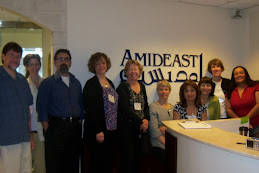
On Monday, we visited an American military base in Kuwait—Camp Arifjan. They gave us a folder which included our schedule for the day. At first, I rolled my eyes at the military rhetoric used and the seemingly excessive attention to detail. (They not only had a detailed schedule accounting for every 15 minutes or so of our time, but they had a seating chart on our tour bus and even scheduled a potty break (called “Comfort Break” at 1615). This military order and predictability was so different from what I’d become used to on this trip. I soon realized that although I'm not the type of person who would adapt well to the military, they do have somethint that I'd been craving: a clear-cut message.
Particularly striking was the briefing we received. The person giving the talk said we didn’t have a lot of time, so he would emphasize the three main points he wanted to make: 1) We are on target to support the president’s plans to leave Iraq and build up forces in Afghanistan; 2) We are focused on improving military processes; and 3) we are exceptional stewards of taxpayers’ resources. Then he gave some detailed support for these main ideas.
After this talk, I realized that what I’ve been looking for on this trip, but have not been getting, is this American communication style. I found it so satisfying because it is what I’m used to at home and in fact what I teach in writing classes: Here are the main points I want to make, and here is my support for those points. (Whether or not these points are true is another issue altogether.)
When we’ve meet with Kuwaitis, Qataris and Emiratis, however, we for the most part have not received this kind of clear-cut message. Sometimes it is because the presenters were not very well briefed on who we were and what we were looking for. The other day, for example, we met with a Kuwaiti Political Science professor at Kuwait University. She said our guide organization had called to ask her to speak, but they never told her what they wanted her to speak about. Oh, well.
But, usually the issue is not the preparation, but the strikingly different communication style. Most Arabic speakers I’ve interacted with, such as the Political Science professor mentioned above, tend to use a lot of words, but at the end of the session, I can’t tell what they said and if they even answered the question. In addition to the different communication style is a reluctance by Arabs to talk about anything negative in public. Partly this is to save face, but partly it is to avoid conflict or discomfort.
I’ve realized that it simply isn’t possible to get satisfying, complex and honest answers to questions on sensitive issues in this kind of trip. One or two hours of a group of foreign strangers barraging someone with questions is not going to yield results. I think it would in fact take years of cultivating relationships, which means sitting and talking with people for hours at time week after week, year after year, before there is enough trust and a good enough relationship to get honest dialogue. Plus, I think I would need to speak Arabic for this to work.
In fact, some of the most interesting sessions for me on this trip have been with Westerners who have made this kind of commitment—people who have lived in the Gulf for 20, 30, 40 or more years and are willing and able to talk freely about their experiences here. They have been fascinating to listen to and have, for the most part, been fiercely loyal to people from the Gulf. Obviously, though, most Westerners do not have the time, resources or even will to cultivate such relationships. Herein, methinks, lies at least part of the problem with Arab-American relationships.
Friday, July 2, 2010
Did you just say something?

Friday, June 25, 2010
Dust In Araby
So my Fulbright-Hays fellow tribe member Ruth and I decided to remedy the situation by creating our own Kuwaiti literature. The following story is the fruit of our efforts. (We alternated entries. Ruth wrote the first paragraph, I countered with a second, and so forth.) Enjoy!

Inside the Ghani Palace.

Captives on a dhow


Ladies Saloons are everywhere in the Gulf. Considering that alcohol is illegal for Muslims, this is truly shocking!
Dusk in Araby
A Joint Production by Ruth Benander and Debra Beilke
The Ghani Palace Hotel crouched on the shores of the Arabian gulf, her faded glory gently decaying into the desert. Once she may have been considered lovely, but her charm had gone grey, and the process had not been graceful. In her later years, she received few guests into the warrens of her hallways, and when she did, it seemed to come as a great surprise. As her splendor waned, she became more of an architectural bookmark for beach front property rather than a page of text for some form of holiday nostalgia. Foot steps in her halls and many stairwells raised dust and sent the staff into a panic. But her bulky shadow could hide money as well as dust, and in the freewheeling blackmarket of the Gulf, this made her attractive.
Despite the mosque-studded skyline, the Kuwait City of the Ghani Palace, its own parallel universe, teemed with vice of all kinds—opium dens, beer-induced belching contests, and ladies’ saloons, to name some of the more rampant examples of sin in this den of iniquity. Yet lurking even deeper beneath the surface was something worse, far worse—an international ring of academic human trafficking known to insiders by the code name Fulbright-Hays. The latest crop of FH captives were trapped in a dhow that had been anchored close to the shoreline for weeks since they could not confirm their booking at the Ghani Palace.
Undercover agents from the Dubai police department were appalled at the human misery they discovered (via hidden video cameras rigged to the dhow’s interior.) The middle-aged captives were rolling in agony on the deck of the dhow as it rocked back and forth, back and forth, back and forth in the waves and the 120 degree heat. Already miserable from sea-sickness, the hapless academics were tortured even further by the techno-funky rap music pounding so loudly the reverberations were felt in Baghdad. Although the Dubai police (henceforth known as the “Dubai Boys”) felt the pain of the FH captives, they did not rescue them—not yet. They needed to watch and wait in order to uncover enough evidence to convict the king pin of this human trafficking. Daily, the Dubai Boys were learning more and more about this powerful Godfather. They knew he was headquartered in Washington, D.C. They knew his name was Jerry. They knew his days were numbered.
It was noon in DC, seven in Kuwait, and Jerry was worried. The men holding the academics reported that yet another academic had requested to move to another location on the dhow, and several were complaining that the internet connection on the dhow was slow. Three had begun to clean the dhow, much to the dismay of their captors. This was not how humans being trafficked were supposed to behave. Worse yet, they were all taking notes and competing to interview their captors, each crafting clever questions to expose their captors' world views and cultural identities. Jerry knew things were going from bad to worse when he discovered that the academics were blogging about their unique perspectives on the nature of human trafficking through ethnographic explorations and chronicling the disorienting dilemma of such participation. They drove their captors crazy by constantly trying to critically reflect on their experience. Jerry knew he had to pawn them off soon on some university looking to contract faculty to teach English as a second language for low wages. How else could the knowledge economy be supported except through cheap academic labor to construct the foundations for the best educated populations in the world? It was dirty work, but someone had to do it. Jerry just saw himself as another epistemological middleman. He contacted his man, Jamal, in Kuwait.
Jamal sat on the roof of the Ghani Palace watching the sun set over the broiling city, throwing cigarette butts into the roof-top pool. He fondled his prayer beads as he reflected on the Fulbright Hays dilemma. Clearly, something had to change; the dhow was no longer a safe place to keep his captives. But where to transfer them? As the hot desert winds began to whip themselves into a frenzied sand storm, Jamal had a brainstorm. Why not move his human cargo to the Ghani Palace? Nobody would ever think to check for them in the Palace. It never occurred to anybody to check into the Palace. It was the perfect solution. There were a few minor problems--such as the need to train his operatives how to put towels in the hotel rooms, how to clean the sinks, how not to look confused when a hotel guest tried to check in—but these could be easily resolved.
Two hours later, Jamal was riding the waves of the Arabian Gulf on his jet ski as he raced towards the dhow at full speed. He was followed by a twelve-pack of Filipina operatives in matching outfits on their own jet skis. He was feeling good, full of resolve. He and his operatives would climb on board stealthily and grab the captives from behind. Before they transferred them to the jet skis, the Filipinas would, of course, offer them coffee and a selection of chocolates. Working in the underbelly of academic trafficking is no excuse to behave like barbarians, after all, and protocol had to be observed.
Suddenly, in the dark and stormy dusk, a door slammed, a maid screamed, a pirate ship appeared on the horizon. The maids scattered in confusion, their jet skis making a maze of wakes that shook the dhow like a flag in the stiff breeze. Jamal leapt from his jet ski to the dhow, desperately clambering up the ladder, slick with the two-stroke engine sheen left by the hordes of jet skis. He was unprepared for the sight that met his eyes. The dhow had been transformed into faculty offices. Surrounded by reference texts, maps, and jumbles of flash drives, the academics looked up.
"Do you have any cold water?" one asked distractedly, "It's rather hot. How can I be expected to complete my curriculum project if there isn't a cold bottle of water to drip all over my notes?"
“I’d rather have a beer,” muttered one under his breath. “When I was trafficked in Ghana, at least they had plenty of good beer.”
From a heap of books and papers, another academic peered at Jamal and asked, "Where are your parents from? Do you have national rights? Did you go to university in the United States? How do you feel about the efficacy of the parliamentary system in a country where family clan loyalty is still an entrenched decision making protocol? "
A third academic marched briskly up to him and said, "Your maps are out of date. You only have maps from the 1940s. Have you noticed that things have changed? You can't still list pearl diving sites in maps of the 21st century because that is merely a rhetorical invocation of the past. There is no place for rhetoric on maps." She glared at a stunned Jamal.
Yet another captive, who lay groaning with sea-sickness, mewed feebly from across the dhow, “Do you know of ANY Kuwaiti authors? Any at all? There must be at least one Kuwaiti Jane Austen wannabe…”
A distinguished academic in the back shouted, "This hummus is terrible! Give me a proper kitchen and I'll make you hummus that will knock your eyes out."
Jamal sat down. Who were these people? He was promised young pretty girls with pert American accents. It was supposed to be easy: take their passports, promise them authentic exotic experiences, and hand them over to the American University. This crop of contract workers did not look at all like pretty young girls and taking their passports appeared to be as easy as finding edible food at the breakfast buffet of the Ghani Palace. "I have to think," Jamal said, voicing his confusion aloud. The result was immediate. All the academics retreated to their piles of notes and left him alone. Someone had to think: they understood that.
Jamal looked disconsolately, and then with growing hope, at the approaching pirate ship which appeared to have Dubai Police stenciled on the side. Yes, he was correct: it WAS the Dubai Police, those high-tech superheroes of justice who were so effective at stomping out crime in their own emirate that they had been recruited to clean up in Kuwait as well. Jamal knew that the Dubai surveillance apparatus was second to none. He knew, too, that their gig was up. They were busted. What to do? He made his decision: he would give himself up to the Dubai boys and tell them all he knew about Jerry. He hoped they would be lenient on him. After all, he was just a low-paid contract worker himself. Why should he go down for the Godfather’s wrongdoings? If he were lucky, he might get off with 100 lashes and deportation to Egypt.
He stood up on the front deck of the dhow and waved a white flag at the Dubai Boys. From the bow he had a better view of the approaching ship. The Dubai Boys had spared no expense. The finest calligraphers in the world had stenciled the gleaming white cutter, the whitest in the world. The cabin towered above the deck and was the tallest cruiser cabin in the world. And what was that tall white structure in the back? It looked like a ski slope….it WAS a ski slope—the tallest manmade pirate ship ski slope in the world. Unfortunately, the entire boat was not occupied, as several cabins remained empty since the construction of the boat. The interior was not quite finished, but none of that mattered: from the deck of the dhow, they look good. The best in the world.
As the Dubai Boys pulled alongside the dhow, Jamal had second thoughts. He figured it might be better just to lie low. His English was good, he was wearing cargo shorts, and if he could just get his hands on a bulky man-bag, he might be able to pass for a professor. Quickly, he huddled behind a nearby stack of papers and tried to look interested in minutia.
The police were getting busy. It took some time to rescue the academics. As soon as the Dubai Boys thought they had them all in one place, two or three would wander off. One kept requesting coffee. Another briskly informed the police that it was time to pee, and half the group disappeared into the bathroom. In a desperate attempt to get the academics off the dhow, an officer announced that there would be coffee and snacks served on the other boat. The effect was electric; most of the academic, now plus Jamal, were on the police cruiser so fast the dhow hardly rocked, but on the way over two of the academics got distracted and leapt overboard. Fearing some kind of bizarre escape from rescue, the Dubai Boys looked over the railing. There were two middle aged ladies paddling around next to the boat.
“Look at us swimming!” they called, “Does any one have a camera to document us swimming in the Gulf!”
The Dubai Boys pulled them out and firmly locked them in the cabin to drip all over the sofas and not create more distractions while Jamal clutched his makeshift man-bag to his chest and hoped he would not be noticed. The Dubai Boys did not have time for details like counting human trafficking victims. Since there was no human trafficking in Dubai, they actually had little experience with the crime. Only 23 cases were recorded each year in Dubai! As a result, they figured they would just liberate the academics in Kuwait City and let them figure out the details. Jamal had no cause to worry. Maybe, he thought, this was his ticket out of the Ghani Palace and on to better things. He planned his new future during the trip back to shore.
On shore, a new crisis presented itself: where to put the academics? The Dubai Police were not interested in some measly victims of human trafficking. Who could believe them anyway: they probably came to work as contract educators for the American Universities on their own, planned a dhow trip, and got stuck out there. And lost their passports. And had unrealistic expectations about their work situation. They probably brought it on themselves. The Dubai Police were more interested in the mysterious Jerry. The academics could tell them nothing except that he had booked them rooms at the Ghani Palace Hotel. If the Dubai Police couldn’t get a lead on Jerry, they at least discovered a block of rooms reserved and paid for at the Ghani Palace. But there were only rooms for ten and there appeared to be eleven in the group. Jamal tried to make himself look smaller and more erudite.
“Make the guys room mates,” barked the Dubai Police sergeant in a sudden fit of inspiration, and the confused desk clerk tried to figure out how he would give the guys rebates, as the sergeant requested. The desk clerk was better at intimidating young women than booking guests into a hotel. These were two completely different skill sets. He knew guests needed keys, so he just started handing out keys. It worked: they all went away. The academics, the police, the guys from the pool hall down stairs who had come to watch the show: they all went away. A dusty calm resettled on the reception area of the hotel. The desk clerk went out to give tuna to the stray cats, so he did not hear the phone begin to ring as the new guests he had given room keys to discovered that they were living in a building whose maintenance had been neglected and this neglect needed to be instantly reported, noted, addressed, and critiqued.
Jamal went back up to the rooftop pool to smoke. He was back where he had started, but he felt changed. He had narrowly escaped, and it seemed that Jerry was incommunicado. What to do? He had rather liked the eccentric tribe of the professoriate. They were geeky but fun. He liked his man-bag. It was so much easier than carrying everything in his pockets, and there was room for water and a hat. He contemplatively flicked another cigarette butt into the pool and wondered if he were too old for graduate school.
Thursday, June 24, 2010
Something old, something new, something Muslim, something blue

Construction is a constant in Kuwait.


This block of renovated traditional villas is rare, but becoming more fashionable.


These buildings are across from my first hotel. This is gulf-front property in a fashionable district of the city.

Modern high rises dominate the cityscape.
Friday, June 18, 2010
New York Times article about Qatar and a response by a Qatari woman
By MICHAEL SLACKMAN
Published: May 13, 2010
DOHA, Qatar — Citizens of Qatar appear to have it made. They tend to drive big cars, live in big houses and get big loans to pay for big watches and an outsize lifestyle. They have an army of laborers from the developing world to build a sparkling skyline and to work whatever jobs they feel are beneath them. And their nation has enough oil and gas to keep the good times rolling for decades.
So why do so many people here seem so angry?
The problem, many Qataris say, is that they resent being treated as a minority in their own country, which is what they are. Citizens make up about 15 percent of the nation’s 1.6 million people — a demographic oddity that fuels a sense of privilege and victimization.
“The priority always goes to the foreigner,” said Ali Khaled, 23, who is finishing his government-financed education in London.
His cousin, Omar Ali, 24, a high school dropout who works as a technician in an electric company, readily agreed: “They always think the foreigner is better at any job than a Qatari, even if the Qatari is perfect at the job.”
In many ways, they appear to be right about how they are perceived.
“Qataris are very spoiled,” said Mohammed Saffarini, a non-Qatari Arab who serves as research director for health science at Qatar’s Science and Technology Park. “They are only valuable in this cultural and political context,” he added, contending that Qataris often lacked the skills, education and qualifications to be competitive in many other economies.
On the surface, Qatar appears to be on a roll. This peninsula of sand jutting into the Persian Gulf has leveraged its oil wealth and unbridled ambition to garner a world-class reputation on many fronts: international relations, art, higher education. But at home, there is tension, anger and frustration between Qataris and foreigners.
“It’s all a sham; it’s all a veneer,” said Dr. Momtaz Wassef, who was recruited from the United States to serve as the director of biomedical research for the Supreme Council of Health. Now he says he is disillusioned with Qatar and is planning to leave. “They never admit they make a mistake,” he said. “They only say they are the best in the world.”
Dr. Wassef’s wife asked that he not be quoted until he left Qatar, but Dr. Wassef would have none of it. “I don’t give a hoot,” he said, clapping his hands together for emphasis.
Qataris do not see themselves as coddled. Sure, they do not have to pay for electricity, water, education or health care, and they are given land and low-cost loans to build houses when they marry. They are eligible for public assistance if they do not have a job, often receive generous pensions and acknowledge they will not take any jobs they do not consider suitable for them.
But they also complain that they do not get paid as much as foreigners, and that foreigners get most of the top jobs in critical industries, like finance, higher education and the media. There is also pervasive frustration that English has become the language of employment, not Arabic, and that local hospitals, restaurants, markets and streets are always crowded with foreigners.
“There is a crisis here,” said Muhammad al-Mesfer, a political science professor at Qatar University. “The foreigners are crowding us out.”
The tension in Qatar is similar to what has surfaced in Dubai, United Arab Emirates, where local people are also vastly outnumbered by foreigners and are sometimes likened to colonial rulers in their own land.
“There are about 300 employees at my work and only 4 or 5 Qataris,” said Mr. Ali, the technician at an electric company. “I walk into work and I feel like I am in India.”
He said that the foreigners were never willing to teach him new skills, so he had lost motivation.
“I have been working there for three years, and I still haven’t fully grasped the work,” he said. “I go to work to drink tea and read the paper.”
During a seven-day visit to Qatar, conversations with expatriate workers and Qatari citizens almost always turned to the topic of distrust, even during the most mundane of encounters.
“I am Qatari, and this country is for me,” a driver shouted as he forced his way into a parking space that a Canadian driver had also been trying for. “This is my country.”
Part of the frustration appears to stem from the lack of an effort to address the differences. People here said that when complaints had been raised, those who spoke up got punished. Foreigners get sent home and local people lose their positions, they said.
Qataris and foreigners alike described a social contract that offers material comfort and financial reward in exchange for not challenging the government’s choices. Qatar is a constitutional monarchy led by Sheik Hamad bin Khalifa al-Thani and his council of ministers. For many, the bargain is worth taking.
“To be honest, I’m comfortable and the salaries are good,” said Ibrahim al-Muhairy, 29, a Qatari high school dropout who said he earns about $41,000 a year working for the government as a security guard in a mall. “Everyone is getting what he deserves and more.”
But there are plenty of others who are unwilling to ride away silently in their Mercedes sedans, like Ahmed J. Abdul-Rahman Abdul-Malik, a former news anchor. He said he was furious that he had not been hired to read the news on Al Jazeera, the popular satellite news channel that broadcasts from here. He has written opinion pieces for a local newspaper complaining that Qataris are now treated as second-class citizens in their own country.
“I met with my friends last night, we joked, we are all ‘ex,’ that means unemployed,” he said, as he climbed into the driver’s seat of a Mercedes sedan. His diamond-crusted watch glistened beneath the parking lot lights.
Moza al-Malki, a family therapist, said she was angry, too. She said that she had lost her teaching position when she complained that an Indian woman was hired to run a counseling center that she said she had set up. “We are all angry for staying at home,” she said.
A moment earlier, she turned to the Filipino woman walking one step behind her — a servant carrying bags — and told her to go look around the mall they were in while Ms. Malki ordered breakfast. Ms. Malki ordered a croissant with cheese, sent it back because it was too hard, and then settled on an omelet.
Mona El-Naggar contributed reporting.
A version of this article appeared in print on May 14, 2010, on page A7 of the New York edition.
---------------------
DEAR READERS: THE FOLLOWING RESPONSE IS TAKEN FROM A QATARI WOMAN'S BLOG: http://thebrirafile.wordpress.com/. I RECOMMEND THIS BLOG TO YOU.
Author brira
Thank You Michael Slackman
17 May
By: Bint Khalid - (in response to New York Times’s article: http://www.nytimes.com/2010/05/14/world/middleeast/14qatar.html)
It is a sad misfortune for Michael Slackman to come for a week’s stay in Qatar, point to the sense of disappointment and the outward appearances of Qataris without looking into the deeper underlying causes of their dissatisfaction.
Now except for Slackman’s heinously shallow portrayal and generalization of Qataris’ characters, I as a Qatari would like to raise my right hand, and solemnly swear to tell the truth and nothing but the truth so help me God. Deep sigh. What Mr. Slackman has divulged in his article “Affluent Qataris Seek What Money Cannot Buy”….
Is the truth.
But…Is it the whole truth?
Dissatisfaction of workers in Qatar whether Qataris or expats is an awfully complex subject. It is a topic that is multi-faceted on so many layers that one would have to write a book about it, or it could possibly be a subject for sociological research (recommended). It is immensely naïve, unjust and superficial to state that Qataris are dissatisfied and frustrated in their home country simply by attributing this to them being spoiled and pampered. Do not make the erroneous assumption that money is simply handed out to Qataris.
With regards to general employee dissatisfaction in Qatar then one should take a look at how performance evaluation is conducted, if ever. Take a look at promotion and reward policies and see if they are implemented fairly. Come and see whether your professional background and qualifications are as significant as ‘who you know’. Obviously these affect both the locals and expats of Qatar alike.
However, in the case of Qataris, not only do they have to contend with such a system but they must also struggle with the publicized label of being ‘incompetent’ and ‘lazy’ (which somehow idiotically is a description attributed to the whole population of Qataris – some 300,000 people). Qataris have to suffer the superior attitude of foreigners ‘who know what is best’ for Qatar and its people. What about forced retirements of Qataris who are in their 50s and at the peak of their professional experience and whose credentials are as thick as books. Did I tell you about the instances where people are employed with fake qualifications and are placed in managerial roles supervising those more qualified at the job than they are; like the English “engineer” who turned out to be a former taxi driver in his homeland?
So a typical Qatari’s lifestyle in not the same standard as it is in most places around the world. Yes we get that. However, this lifestyle is adopted by many foreigners who come to work in Qatar as they find that their employment contracts include a two floor villa which may embrace a swimming pool, paid travel expenses for the whole family, covered education for their kids at top schools, covered medical expenses for the family, house cleaning services, free use of company car and a personal driver, membership for a health club, not to mention the salaries that go up to ten times what a local would receive for the same position… Would you like to join us in Qatar?
So, the general view is come to Qatar, get rich fast, then leave. I wonder how much Dr. Momtaz Wassef is making?
With regards to feelings of irritation, lack of understanding or distrust between Qataris and foreigners then all these are gathered into a parcel and placed under the heading of Culture Clash, which is the misunderstanding and disagreement between different cultures.
Arabian culture is similar to those of most Eastern cultures in the sense that it is a collective society. Arabian culture emphasizes the group. Confrontation is avoided and disagreement is conveyed privately to protect the person from ‘loss of face’. Words such as “Inshallah” (God willing) are used to convey negative expressions instead of saying a direct ‘No’. Respect for elders, the significance of tradition, family honor and expectations, concern for one’s reputation are deep-rooted principles. It is a fact that Arabs are generous, polite and value loyalty. You may compare these values to those of individualist cultures which Anglo societies fall under. These tend to place emphasis on the individual, goals and expectations of the individual are promoted, there is no need to conform to a group, and people are encouraged to rely on themselves.
Lack of awareness, lack of communication and misguided beliefs are at the root of the issues of resentment between Qataris and the others. Is it possible that culture shock may be another cause for the confusion? After all Qatar’s Arabian culture is drastically different from what most foreigners are accustomed to. Symptoms of culture shock include: heightened irritability, constant complaints about the climate, utopian ideas concerning one’s previous culture, continuous concern about the purity of water and food, fear of contacting local people, refusal to learn the language, a pressing desire to talk with people who “really make sense”, and preoccupation with returning home.
The unchangeable facts that you are stuck with as an expat in Qatar are that: organizational structures are very hierarchal, Arabian culture in general is not particular about punctuality, and “Inshallah”, although often construed as a NO, depending on the circumstance is also used as a polite and somewhat formal way of saying YES. Not to mention that Qataris are warm people and extremely friendly. In my own opinion, Qatari dissatisfaction is not aimed at expats themselves but at government policies that are overly accommodating to foreigners in managerial roles.
As for my friend Michael Slackman, regrettably one cannot help but perceive the tone of ridicule aimed towards the enigma that is our Arabian culture. This might be partly our fault, possibly because many of us do not take the time to explain why we behave the way we do? Or believe what we believe? Or maybe we assume that we have a right to act according to our own values as others act according to their own? Maybe we just like being mysterious and exotic?! Who knows.
Slackman’s observations are all correct. Mr. Ahmed probably does have a diamond encrusted watch and he most likely does drive a Mercedes. I believe Ms. Al-Malki would ask her maid to take a stroll in the mall while being interviewed, and return her croissant if she was unhappy with her choice for breakfast. I’m not sure when returning your food in a restaurant became a crime against principles of etiquette.
It is fascinating how in his seven day stay Slackman has taken the time to observe The Qatari Species, point to the outward ‘veneer’ as many others do, pick at occurrences and merely read them in a way that would confirm their own convictions about what the Arabian culture embodies. To sum up the advertised perception: a wonderland where local inhabitants are a group of ungrateful, apathetic, impassive little devils, running amok with bulging purses and trailing servants holding the tails of their long white or black traditional dress.
Now really what did such asinine observations add to the typically depicted Arab persona? I believe all credit should go to the foundation already laid by Hollywood, CNN, Fox News, George W. Bush, Osama bin Laden and numerous more.
But thank you Michael Slackman because if it weren’t for your article “Affluent Qataris Seek What Money Cannot Buy” many would never have come across what was written above.
Mr. Slackman Replies…
” Dear Bint,
Thanks for the email.I’m happy to disagree. I was not, in anyway, dissing Arabian culture. Indeed, the problems Qatar faces today — most of them anyway — are a result of colliding with modernity, and are not inherent in Arabian culture. I’m not sure why you chose to retreat to that form of defense. Frankly, I think you are too smart for that.It’s interesting to me that you pointed to the two wealth Qatari’s I quoted at the bottom of the piece and not the other middle income people higher up, the security guard and the technician and the computer scientist. But then, they would not have validated your point in the same way.In any case, I will say one thing, this is what journalism does at its best, in my view, promote discussion, introspection and a free and open exchange of ideas. You know, this kind of reporting happens everyday in countries that have and promote a free and independent press. I’m delighted to see, as you said, that so many people in Qatar are now discussing these issues and challenging each other. Agree. Disagree. It’s a great marketplace of ideas. Check out the blogs, just like yours. I think that’s great.
Thanks for writing.Michael “
Thursday, June 17, 2010
National Identity, continued

Dear Gentle Readers: The comments in this post are a continuation from my last post. If you haven't read my last post, you may wish to do so first. (Not that I am telling you what to do; I would never do that. It was just a suggestion--no need to get so huffy about it.)
(Notice the modern high-rise with the traditional architecture added seemingly as an after-thought. A metaphor for the new Qatari identity?)
Based on the paintings at the FANAR Center for Islamic Culture, it would appear that Qatar's identity is based on fishing, pearling, hanging out in the desert with falcons, and fighting the occasional war with camels prancing in the background. The problem with this pictorial representation is that it has little to do with Qatari people's lives today. The pearling industry was destroyed by the development of cultured pearls in Japan; people live in air-conditioned homes in the city, not the desert; whatever fishing is done is relegated to foreign migrant laborers; and this peace-loving country tries very hard to avoid conflicts with any of its neighbors.
Most of the wealth comes from gas and oil, not camel milk and palm dates. The vast majority of working Qataris are employed in public service or education, and the cityscapes are mostly of the modern. western variety. Shopping is the national pasttime, and the malls (rather than the souqs) are the favored community gathering spots. English is printed and spoken everywhere. To be sure, most signage and public documents are ALSO in Arabic, and mosques stud the landscape.
As I think I've already mentioned, this hyper-modern development has happened astonishingly quickly--so quickly that many people are a little dazed and wondering who they have become. In case they forget, they can always go to FANAR to see pictures of their authentic national identity.
Tuesday, June 15, 2010
National Identity
 Qatar's representation of its history:
Bedouin men in the desert enjoying tea and a talk. Note the obligatory falcon to the left. Note the absence of women in any of these paintings.

Qatar's self-image today--pro-business, pro-West, pro-money.
It's always interesting to me to observe how nations (or other communities) define themselves. It's particularly interesting in a place like Qatar. Although this area has been continuously inhabited for thousands of years, there is very little material evidence of this inhabitation--no old towns, very few artefacts and little to no written record. The Arabs who lived here were mainly Bedouins who lived in tents and moved frequently. They could not afford to be burdened with material possessions. Some people lived in towns and made their living by fishing and pearling, but apparently they lived in houses that did not last long. The culture was oral rather than literate, so there is no tradition of publishing (although there is a strong tradition of oral poetry.)
The other day we visited FANAR, a center designed to educate the public on Arab and especially Muslim identity. On the ceiling in one of the rooms were paintings depicting Qatari culture as they are defining it today. I have reproduced these paintings in this post.

Traditional buildings in town.


This is The Fort. It appears in all of the representations of Qatari history. This icon of the past was actually built in 1937. This is probably the oldest (or one of the oldest anyway) remaining building in Qatar!

Fishing has long been a source of food and income to all of the Gulf countries.
Saturday, June 12, 2010
Doha Adventures, Part I

So, like, the other night I was hanging out at the Villagio Mall in Doha, Qatar. I was just enjoying the beautiful canals,

and watching the gondolas float by gently,

when I met this Iranian dude named Sultan. We exchanged glances and fell immediately in love. He swept me off my feet, dropped me in a gondola, and rowed me home to his palace.

At first, he was wonderful. He showered me with expensive jewelry,


(In case you didn't believe that was an opium cup. Dear reader, I would never lie to you.)

I put up with the opium abuse, but then it got worse. I discovered that he had bestowed a priceless necklace on my former roommate, Karen (the Shameless Hussy)!